Showing posts with label Facebook. Show all posts

Building Platform: What Most Writers are Getting Wrong


Writers know we need a "platform" these days.

That means we need to be on Twitter and FaceBook and Google+ and LinkedIn and Pinterest and Tumblr and have a blog with a ton of followers and get 100s of reviews on Amazon and Goodreads and drive ourselves batty keeping up with all of it, because…who needs to write books? It's all about racking up those numbers, 24/7, right?

That would be a no.

Last year I wrote a post about 7 Ways Authors Waste Time Building Platform and it's been one of our most popular posts.

But the majority of writers are still running on the old social media hamster-wheel, pursuing those elusive numbers. I even see writers begging for money on IndieGoGo and Kickstarter, so they can "buy Twitter followers and Facebook likes." I hope nobody's silly enough to give it to them.

Because those numbers mean almost nothing—even less now than they did a year ago.

If you write narrative (novel or memoir), all you need is a social media presence, not huge numbers. (Nonfiction is a little different. More on that below.)

You do need to be Googleable. You can get Google's attention by commenting on blogs, having a Google Plus, Twitter and/or Facebook account and maybe a blog.

But guess what is the #1 thing an agent, editor or reviewer wants to find out when they Google you?

Whether you're a pain in the butt.

Seriously.

They don't care much about your Alexa, Klout or PeerIndex rating. They aren't all that interested in how many Tweeps, blog followers, LinkedIn contacts, Google Plus circles, or Facebook friends and/or likes you have.

I know you've heard otherwise, but that info probably came from marketers, not actual agents, editors or influential reviewers. Not recently anyway.

What Publishing Professionals Look for When they Google an Author


1) Is this person making the effort to network on social media?

2) Is this person an a**hole, volatile, entitled, disrespectful, or a self-involved jerk?

Don't just take my word for it:

  • Super-agent Kristin Nelson (obviously trying hard to maintain her legendary niceness) put it this way in a roundtable discussion with Scratch magazine last week: "In terms of social media, a lot of times we’re just looking to see if this is somebody we want to work with or are they really … what’s the word I’m looking for … strange on social media circles, or lacking a level of professionalism in their online presence. Let’s just say there are some folks who have a Twitter/Facebook presence that’s a little … aggressive or antagonistic."
  • Agent Sarah Burnes said in the same discussion that she looks at the whole "social media footprint. The truth is you can tell a lot about a person online."
  • Rob Spillman, editor of the prestigious literary magazine Tin House, says he's looking for “literary citizenship" and people who are "supportive of other writers".
  • Canadian agent Carly Watters wrote on her blog earlier this week that she's looking for: a website or landing page, some social media "proficiency", a professional attitude, good personality, and no blogposts detailing your personal submission woes to the general public.

In other words, no matter how good your numbers are, if you flame out on writing forums or use your blog to badmouth the publishing industry, complain about rejections, or put down other authors, it doesn't matter how many likes, hits, clicks or followers you have.

So be nice. Practice the Golden Rule. Don't be a whiner or a bully. And stop listening to marketers and system-gamers who tell you it's all about building up numbers. 

This is because:

  • Most publishing professionals don't care 
  • Those numbers do not equal sales, and have become increasingly meaningless—as you'll see below


Why You Should Stop Worrying About Social Media Numbers


Social media numbers are being gamed—and the problem is getting worse. They're also bought and sold from "click farm" sweatshops that have sprung up all over Asia.

This week Forrester Research reported that marketers and publishers are coming to believe, "The paid ads Facebook encourages them to buy often lead to 'fake' fans generated by 'like farms'."

And an article in the HuffPo on how social media "likes" are bought and sold says:

"While the Federal Trade Commission and several state attorney generals have cracked down on fake endorsements or reviews, they have not weighed in on clicks. Meanwhile, hundreds of online businesses sell clicks and social media accounts from around the world. BuyPlusFollowers sells 250 Google+ shares for $12.95. InstagramEngine sells 1,000 followers for $12. AuthenticHits sells 1,000 SoundCloud plays for $9."

In other words, this isn't even illegal, so everybody's doing it.

But that doesn't mean it's smart.

Because large numbers of clicks/likes/followers, etc, now mean absolutely nothing.

Here are some other iffy and pointless ways to waste time and money on meaningless numbers:


Purchasing LinkedIn connections and email addresses


This week I got an email from an author I'd connected with on LinkedIn. She claimed to write reviews for the Wall Street Journal. She offered (in all caps—always a bad sign) to give me a book review in exchange for… a list of all my LinkedIn contacts.

How's that for creepy?

Are there really people who will sell out their accountants and doctors and everybody they do business with in exchange for an iffy book "review" from a complete stranger?

But it gets worse. She also promised the names and contact info for "2000+ Amazon book reviewers".

Oooooh! I'd be able to spam 2000 Amazon book reviewers and get them to all hate me at once? Hmmm. That sounds like a good marketing plan…

My agent Pam noted this was probably a sock puppet who was gathering LinkedIn contacts to sell on those click-selling sites.

But the underlying assumption has a basis in a sad fact: many authors will pay to rack up meaningless numbers, whether a quantity of nonsense reviews or "likes" or "contacts".

And even if you're not paying cash for reviews and clicks, if you're trading with other authors, offering prizes for "likes", or whatever, you're wasting time.

Fake Facebook "likes" 


Many writers are duped by Facebook into paying to "boost" pages to get hits on their author page.

They tell me they do it because it gets "results". By which they mean they get more people to click on a "like" button.

But when I ask if those "likes" translate to book sales, the authors go strangely silent.

So I'm going to say it loud: SOCIAL MEDIA NUMBERS DO NOT EQUAL BOOK SALES.

A handful of real friendships and loyal readers mean more than thousands of nameless, faceless numbers.

Author Jonathan Evison advised writers at the annual conference of the Association of Writers and Writers Programs, “If you don’t like Facebook, then just don’t do it … It’s not about broadcasting. It’s about connections.”


Unwilling Newsletter Subscribers


I've been "subscribed" to dozens of newsletters by authors I don't know in genres I don't read. Maybe because they've queried me for a guest blogpost, or we've communicated on another subject. Or I've commented on their blogs. Or they just take my contact info off this blog. They've got my email address, and dammit, they're going to use it! Their marketing consultants told them to!!

But this is what a lot of marketing people don't understand: annoying people with email spam does not move them to buy books.

As the lawyer known as The Passive Guy said on The Passive Voice this week, "Email lists! What an powerful concept! For 1996."

And Tony Hursh responded to PG in the thread, "Just this morning I was reflecting that I don’t have nearly enough spam in my life."

How about you? Not enough spam?

That's what I thought.

And yet every marketer says you must have a newsletter and send it to as many addresses as possible, regardless of who they are or whether they read your genre. It's NUMBERS, they tell you. NUMBERS!!

I think it's wiser to listen to Mr. Evison. He advises writers that instead of blasting out group emails about their books and events, they should take the time to write a personal email to each friend.

A personal email to a friend. Not a bunch of advertising aimed at some undefined "them" you imagine to be out there.

Auto-Tweets to Fake Tweeps


I think Twitter is probably the medium authors abuse the most. Hundreds of thousands seem to autotweet book spam 24/7. Often to "followers" who have been purchased (and probably don't even read their language.) 

And they can't figure out why their books aren't flying off the shelves.

That's because they don't understand that Twitter is not for direct marketing. People are on Twitter to get news and information. What gets retweeted most is links to original content or news stories.

Social media guru Jon Morrow at Boost Blog Traffic says this about boosting Twitter traffic,

"Consistently tweet the content of the other influencers in your niche (even if they’re your competition), making sure to mention their handle and, of course, include a link to their article."

That's right: the number one way to boost your own traffic is to share other people's links—both unknowns and big influencers. Unknowns will probably thank you and follow you, and the influencer's Tweeps will notice you and you can become part of their clan. They start noticing your other tweets, they might even see one for your blog and come on over and make friends. And eventually take a look at one of your books.

Bestselling mystery author Elizabeth S. Craig (@elizabethscraig) has 26K Twitter followers. I'm willing to bet those are real people who have followed her voluntarily. That's because she tweets the best links in the publishing business. And she has never once tweeted ads for her books. She tweets great content. 

Obsessing about Blog Hits


It's my personal opinion that a blog is an author's most important tool on social media. My blog re-started my career after my first publisher went out of business. It got me two more publishers, an agent, and a blog partner I'd admired since she was on the NYT  bestseller list and I was a wannabe actress reading Ruth Harris novels in the greenroom of a little theater in Southern California.

But none of those things happened because of huge numbers of hits on this blog.

Those things happened because I made connections with people on many blogs: mine and theirs and Nathan Bransford's and Kristen Lamb's and Elizabeth S. Craig's and many, many more.


1) Blogs for Nonfiction Authors


Nonfiction writers need to follow slightly different rules from fiction writers. (And although memoirs are nonfiction, they're narrative, so they're marketed like novels.)

A nonfiction writer definitely needs to work at driving traffic to his blog, because a widely read blog is one of the best ways to establish yourself as an expert in your field.

I advise nonfiction authors to work on a blog for some time before you launch a book, and to comment on the blogs of "rivals" for some time before that. 

But you need an engaged readership, not fake numbers. An attack by a Moldovian spambot is going to boost your numbers through the roof, but it won't sell one person on your idea.

That's why you need to network with other bloggers in your field, and share their content, not sit alone on your blog waiting for hits like a spider waiting for flies.

2) Blogs for Fiction Writers and Memoirists


If you write fiction, you don't need a writing blog like this one, unless you also have a "how to write" book like, ahem, How to be a Writer in the E-Age: A Self-Help Guide.

Novel readers read novels. Blogs, not so much. So if you write fiction, you don't need worry about your stats or your Alexa rating.

Sure, it was fantastic for our egos when we got 50,000 hits last month. It's like the thrill you get from winning a videogame. With about the same real-world significance.

Yes, there was a bit of an uptick in sales of my novels. But I also had attack by the the Amazon sock puppet-trolls—maybe in retaliation for signing an anti-sock puppet petition—which probably helped my sales as much as the blog surge. It's funny how my sales go up when they leave their brainless 1-stars. I think any review gets a book some attention from the algos, no matter the star rating.

But I also see an uptick in novel sales when I visit smaller blogs. Almost any time you reach out to a new audience there will be a flurry of sales.

But the blog surge did put my nonfic book onto several bestseller lists. Nonfiction writers: take note. 

A fiction writer's blog is simply a place for your fans to find you, or if you're not published yet, a way for you to build up friendships in the blogosphere.

Neither of those goals is dependent on a huge number of blog hits. It's the number of engaged readers that matter. You're not going for a million hits. You're going for 1000 true fans. Or even 100, or 50. Real people, not pointless numbers.

Catherine Ryan Hyde is one of the top selling novelists on Amazon. Last summer she bumped J.K. Rowling off her perch at #1.

But Catherine's blog has an Alexa rating down around #4 million. As of this writing, this one is at #132 thousand. (Google, at #1, being the best-rated)

But I probably don't sell as many novels in a month as Catherine sells in a day. She sells books because she has a fantastic reputation, she's been a star since she wrote Pay it Forward a decade and a half ago, and readers feel they know her. People who visit her blog already love her books. They're coming to the blog to get to know her better.

The thing most marketers don't understand is that selling books isn't the same as selling collapsible hoses, Sham-Wows or Perfect Bacon Bowls.

Readers are quiet people. You need to gain their trust. You can't influence them by shouting at them.

Or by being a pain in the butt.

So don't.

And you can stop obsessing about all those silly numbers.

As I said in last year's post: If you're dealing with marketers who are in love with numbers for their own sake, I hereby bestow a rank of 10 million ARA points!!! on each of you. When somebody puts you down for not having a Klout rating over 80, just roll your eyes and say "Klout is so over. I have 10 million ARA points."

Doesn't that feel better? 

What about you, Scriveners? Have you been obsessing about numbers without really knowing why? Have you ever paid for Twitter followers or "boosted" a Facebook page? What do you find is the most effective way to boost your book sales? Or if you're unpublished, how much time do you spend building platform online?


BOOK DEAL OF THE WEEK

Sherwood, Ltd is $2.99 right now, marked down from its $3.99 list price for Kindle US, UK, CA Nook. It's also FREE on Smashwords and on Kobo. (The free run will be ending very soon.) And for book-sniffers (I have to admit to some closet book-sniffing myself) it is available in paper for the marked-down price of $8.54 (regularly $8.99 on Amazon and $12.99 in stores.) It's also on sale in paper in the in the UK for £6.81. (Canadians, I don't know why the paper version isn't listed on the Amazon CA site. I will talk to my publisher about it.)


A hilarious tale of intrigue, romance and spot of murder at a small press in the English Midlands.

"Good Manners for Bad Times" author Camilla Randall (Dr. Manners) could use a publisher…Currently broke and homeless, she would welcome opportunity knocking on her nonexistent door. Eventually it does. Sort of. From across the Atlantic, the upscale pornography press, Sherwood, Limited, is looking to become respectable. Free residency in their Lincolnshire factory is included. How can any well mannered person decline? Thus begin Camilla's adventures with a postmodern Robin Hood… and his band of scary men."…Kathleen Keena

"A wily tale of murder, deceit, and intrigue that can stand with the best of them. Her characters are all too real and her dialogue took me from laughter to chills to suspicion of everybody in the book...Read this book. It will be well worth the time."...David Keith

To anybody who has read and enjoyed Sherwood, Ltd: it could sure use some review love on Amazon US! It's got all 5 and 4-stars on Smashwords, Nook and Amazon UK, but my little anti-fan club have left their mark on the US Zon buy page. 


OPPORTUNITY ALERTS

The Golden Quill Awards: Entry fee $15. Two categories: Short fiction/memoir (1000 words) and Poetry (40 lines max) $750 1st prize, $400 2nd prize in each category. Sponsored by the SLO Nightwriters and the Central Coast Writers Conference. Entries accepted from April 1-June 30th.

Fantasy Scroll Magazine is a new paying-market, upscale SciFi online literary magazine. Now taking submissions for flash, micro-flash and stories up to 5000 words. They are also launching a kickstarter campaign to obtain funding to maintain this as a paying market. They're looking for highly original work in SciFi, Horror, and Fantasy.

Writers' Village International Short Fiction Award. Entry fee £15. This is a biggie. Stories in English up to 3000 words in any genre from anywhere in the world. £3000 First Prize. Judges include iconic mystery author Lawrence Block and Whitbread & Orange short-lister Jill Dawson. £4500 ($7200) in total prizes. The top 50 contestants also get a free critique of their stories. Deadline June 30th.

Flash Prose Contest $15 ENTRY FEE. WriterAdvice seeks flash fiction, memoir, and creative non-fiction running 750 words or less. Enlighten, dazzle, and delight us. Finalists receive responses from all judges. First Place earns $200; Second Place earns $100; Third Place earns $50; Honorable Mentions will also be published. Deadline April 18th.

GLIMMER TRAIN FAMILY MATTERS CONTEST $1500 prize, plus publication in Glimmer Train Stories, plus 20 copies. $15 ENTRY FEE. They're looking for stories about families of all configurations. It's fine to draw on real experiences, but the work must read like fiction. Maximum word count: 12,000. Any shorter lengths are welcome. Deadline March 31.

Social Media Secrets for Authors, Part IV: How Not to Spam


If you've ever wondered why unsolicited Internet advertising is named after a perfectly innocent meat product, blame Monty Python. In a famous 1970 sketch, the customers in a café are constantly drowned out by a chorus of Vikings singing "Spam, Spam, Spam, Spam... Lovely Spam! Wonderful Spam!" Conversation is impossible because of the "spammers."


But whatever it's called, we don't want to generate it.

This is because:
As I've said before, social media is social. It should not be used for direct marketing. For more in my "Social Media Secrets" here are links to Part 1: How to Avoid Twitter-Fritter and Facebook Fail, Part 2: How to Blog Your Way Out of the Slush Pile,  and Part 3: What Should an Author Blog About?

Here's the "secret" about social media that marketers don't tell you: it should be used for making friends, not direct sales.

As I keep saying, you wouldn't wear an advertising sandwich board to a Chamber of Commerce mixer, but a lot of authors are doing the digital equivalent.

  • An ideal use of social media is when a digital friend picks up your new book because she loves your genre and she's watched you agonize over getting a publisher or struggle through all the hoops of self-publishing. Then she tells all her friends how the book made her laugh/cry/escape when she was going through her recent crisis. You connect emotionally with people, which is why your book takes on meaning for them.
  • A bad use of social media is when people go to follow you on Twitter and find nothing but a stream of identical tweets saying "buy this book"...and nothing to suggest you're anything but a self-involved artificial life form. 
  • Or they visit your blog and it has nothing but posts bragging about how everybody loves you and your books and you're just so doggone...full of yourself! Yes, it's possible to spam your own blog. Don't do it. 
But it's not always so easy to tell if you're spamming. What is the line between "savvy marketing" and spam?

Truth is: the rules can be different for each site. But finding them can require tech savvy and knowledge of legalese (and good eyesight: they're usually written in a flyspeck font.)

Here are the rules I've managed to discover, mostly by breaking them. As Ruth and I say, we make the mistakes so you don't have to.

How not to Spam on Facebook

1) Don't link to your blog or website from anything but your own page or a designated thread. Links to your blog or website are considered spam on Facebook, no matter how useful. They'll put you in Facebook jail (freeze you out of your own page) if you post links to your blog more than a few times a week, even in a private group.

This happened to me. Somebody in a group asks at least once a week about using song lyrics in fiction. So I used to post a link to our guest blog piece from Michael Murphy that tells you how to get rights to song lyrics .

But I was wrong on that. Unwritten Facebook rules say you can't do that, and a self-appointed vigilante will click the "report for spam" button and you're off Facebook for a week or more and your blog is flagged forever as "spam." Much hoop-jumping is required to get reinstated. Don't take the chance.

2) But Facebook has NO problem with links to your buy page on Amazon or other retail sites. So it's fine to put "buy my book" posts on as many Facebook pages as you like. Just make sure they're promotion sites like Canadian Free and Promoted Books, Authors 99c E-Book Promotion , or Free Books 4 U and follow site guidelines.

3) Don't friend more than a few people a day. Even though Facebook is constantly hounding you to "friend" people, it's a trap. If you actually do what they say, you'll end up in Facebook jail.

4) Don't post a promotion of your book in a group without reading the rules first. Many groups will kick you out for it.

5) Posting promos on somebody else's Facebook page is serious spam. It's a violation of personal space. Nothing will make people unfriend you faster. It's like posting a billboard on somebody's lawn without permission.

6) Never market through a FB direct message. If you're not friends with the person, it will go in the "other" folder with all the proposals of marriage from men with poor English skills and a photo they stole from some CEO's bio page. which means they're not likely to see it anyway. And besides, it's rude. Never use personal messaging for advertising. A direct message is like a phone call. Do you like getting unsolicited "cold calls" from marketers? Yeah. Nobody else does, either.

7) Never add somebody to a group without permission. There's been a trend to add random people to book launch "parties" and other "love my book" groups. Your targets will start to get dozens of notifications about you and your book which will be unwanted 99% of the time. Facebook won't punish you for it, but you're likely to get unfriended. And lose possible sales. Thanks, Tymber Dalton for the addition.

How not to Spam on Twitter

1) Never send those automated direct messages that say, "Now that you've followed me, go like my Facebook and author pages, follow my blog, buy my book and pick up my dry cleaning, minion! Mwahahah."

They're against the Terms of Service as well as causing an auto-unfollow from practically everybody. For more on why not to use automatic direct messaging, here's a great post from social media consultant Rachel Thompson: Death to the Auto-DM on Twitter.

2) Do NOT send direct messages to people you don't have a relationship with. Not even to say "thanks for the follow." A follow is not a relationship. If you must thank for a follow, sent it in a @Tweet. (Not an automated one.)

3) Don't tweet your book more than a few times a week unless you have news like a great review or a sale or freebie run. Otherwise, it's just noise that gets ignored.

4) Don't tweet somebody else's book link just because they ask. Make sure it's in a genre your Tweeps will enjoy. (DO hit the button that says "I just bought [title] by [author] on Amazon when you buy a book. That's a great way to recommend it.)

How not to Spam on Amazon

1) A link to your own book in a review is spam. It can get you banned from Amazon. You can have a title in your signature and post as "Susie Scrivener, author of Scribblings," but without a link.

2) Do not mention your book in the Amazon Forums. Better yet, don't go there. It's troll habitat and very anti-author.

3) Link to your blog ONLY in a designated thread in Kindleboard forums, even if your blog is full of useful information to writers. I learned that the hard way.

How not to Spam on Blogs

1) Never, ever subscribe to a blogger's newsletter just so you can hit "reply" and send an ad for your book. It's happened to me a couple of times. It's insulting and pointless. The ad doesn’t go to the mailing list. It goes to the blogger—who will put you on their list of authors to avoid, especially if the genre has nothing to do with the blogger's interests. Remember this is about making friends, not enemies.

2) Don't link to your buy page from a blog comment. I don't mind links to a blog or webpage—in fact I find them useful—but some people don't like links of any kind from a blog comment, and they'll delete the comment as spam, so be wary.

3) Don't talk up your book or blog in a comment unless it's relevant to the conversation.
  • "I respect your opinion on prologues, but I've got testimonials from readers who love prologues—the longer the better—over at my blog today" is fine. 
  • "This discussion of Marcel Proust reminds me of my book, Fangs for the Memories, a zombipocolyptic vampire erotic romance, $3.99 on Smashwords." Not so much.
How not to Spam on Forums

1) Lurk. Every forum is different. So never say anything in a forum until you've unearthed every rule and hung out for a good long time.

2) Beware "share" buttons. I made the mistake earlier this year of sending out my blog link to a number of sites via the "share" button Blogger provides. This apparently sent it to forums where it should not have gone on Reddit, StumbleUpon and Digg. A nice moderator from Reddit informed me all my posts had been deleted as spam.

3) Better yet, stay out of book-related forums altogether, except small, well moderated, author-friendly ones like Nathan Bransford's, Red Room, She Writes, Critique Circle, or Kristen Lamb's WANAtribe. The bigger and older the site, the more likely it will have resident trolls, bad-tempered vigilantes and anti-author groups.

How not to Spam on Goodreads


1) Don't join a group just to promote your book. Spend a long time talking about other books before you bring up your own. In fact, on Goodreads, it's best not to mention you're an author at all. Take off your author hat and discuss books you've read, not ones you've written.

2) Don't send mass friend requests. This is true on almost all sites. You will be flagged as a spammer.

3) Don't thank a reviewer or someone who has put your book on their "shelf." The new Goodreads author guidelines prohibit it.

4) And especially: never, ever, ever engage with somebody who has given you a bad review or put you on a hate "shelf." Not for any reason. Goodreads reviews are notoriously unpleasant, unhelpful, and snarky. But authors need to learn to live with them.

How not to Spam on Google+


(Updated) Google Plus users seem to be mostly techies and business people who are too busy to engage in a whole lot of childish behavior, so you don't have to be as afraid of troll-vigilantes as on Facebook and Goodreads. But:

1) Posting a link on more than one community page can get you marked as a spammer by Google Plus algorithms.

2) Posting a link without at least 100 words of introduction can mark you as a spammer. Personally, I think that's a shame because I used to just hit the Google + share button along with the Tweet button when I read an article I thought might interest writers.

Google+ is soooooo slow that opening my page and writing 100 words about every link means I can't post as many links. But I guess they want more exclusive content written for Google Plus alone. 

There has been a kerfluffle in the tech world this week because Google+ has changed its TOS and is going over to the dark side, and wants to invade your privacy like Facebook, and may even use your comments and profile pictures to promote products. But there is a way to opt out through this link.

Next week we're going to have a guest post from Google+ guru Johnny Base, who's going to tell us everything an author needs to know about Google+

What about you, scriveners? Have you ever been criticized or punished for spamming when you didn't realize you'd broken the rules? What kind of spam bothers you the most? Do you think spam marketing sells books? 


Book Bargain of the Week

NOW AVAILABLE ON NOOK!! 
Sale extended! No Place Like Home is back to 99c this month since being chosen as "Book of the Month" by the BoomerLit group. Still only on Amazon US, Amazon UK, and Amazon CA ,


"A warp-speed, lighthearted comedy-mystery"...Abigail Padgett
"A fun, charming novel about the rich and less so" ...Karen Doering
"A cross of dry British humor and American wackiness, and it all adds up to a fun read." ...Deborah Bayles

Opportunity Alerts

Writers Conference Alert! The James River Writers Conference returns to Richmond, VA on October 19 and 20 with an extensive lineup of big name agents, authors and literary professionals. They're featuring award-winning book designer and writer Chip Kidd, National Book Award-winner Kathryn Erskine and best-selling author Christopher McDougall. Literary Publicity Firm JKSCommunications, Book Doctors and Pitchapalooza founders Arielle Eckstut and David Henry Sterry will be on hand for advice. You can pitch to agents including April Eberhardt, Deborah Grosvenor, Victoria Skurnick and Paige Wheeler. For details and registration, JamesRiverWriters.org

EBUK Bargains UK now has a blog! Get all the most up to-date info on the international book marketing scene from the guys who wrote one of our most popular guest blogposts ever.

The Sherwood Anderson Fiction Award from the Mid-American Review. $10 entry fee for a story up to 6000 words. First Prize: $1,000 and publication. Four Finalists: Notation, possible publication. You may submit online or snail mail. Details at website. Deadline is November 1, 2013.

J.F. POWER PRIZE FOR SHORT FICTION
  NO ENTRY FEE. The winner will receive $500. The winning story will be announced in February, 2014 and published in Dappled Things, along with nine honorable mentions. The word limit is 8,000 words. Deadline is November 29, 2013. 

MYSTERY AUTHORS! The Poisoned Pen Press, one of the most prestigious small presses, is open for submissions for one month. They open for submissions twice yearly, once during the month of October, and once during the spring. During October, they will accept submissions for regular publication. During the spring submissions period they open for the Discover Mystery first book contest. Please note their entire submissions process is electronic via the online submissions manager, Submittable. Mailed or e-mailed submissions will not be read. They will be accepting regular submissions during the period between October 1 and October 31. 

The Laws of the (Amazon) Jungle—Eight Rules Authors Need to Know to Stay Safe

Update: This is probably now the longest blogpost in history, so I apologize. But I've had important updates from commenters that I'm incorporating into the post. An intellectual property lawyer has enlightened me on a lot of things I had wrong. (Scroll down to Rule #5). And South African romance writer Niki Savage has an update on Amazon's rules for reviewing authors in your own genre (Rule #2) Thanks for all the helpful comments!

Everybody tells authors we must use social media to have successful careers in the E-age, but nobody talks much about the dangers that lurk here.


Here's the thing: the Internet is still the wild frontier. And it's so huge nobody's quite sure how to police it.  Big, loosely regulated social media sites seem to encourage the worst in human behavior. Facebook allows people to make hate pages for celebrities with happy abandon, and the comments on news sites and You Tube can make you want to wash your eyeballs.

You Tube is making some sweeping changes to try to curb some of the more horrifying comments. You'll soon need a Google+ account to log in. (Google+ is set to become the most important player for business in social media. We'll have a post on that in a few weeks.)

Online nastiness is so pervasive that even some literary sites have become more like a jungle full of feces-throwing monkeys than a place for civilized discourse.

Recently, the review site Goodreads (now owned by Amazon) has tried to cut down on the poop-tossing by deleting some ad hominem attack "reviews" and obscene or threatening "shelf" names. Some people decry this as censorship and are protesting by sabotaging Goodreads with thousands of one-star "reviews" on random authors' books.

You can read an overview of the new developments by Pavarti K. Tyler at Indie Reader and Laura Hazard Owen at Gigaom and more at the Passive Voice.

But I fear it will take more than deleting a few reviews to change the online culture of entitlement and emotional brutality.

After I wrote my post on "Gangs of New Media" a few months ago, people contacted me with heartbreaking tales of online bullying in the publishing industry. Authors, readers, and reviewers alike had horror stories.

Respected reviewers had stopped posting to Amazon because of reviewer-on-reviewer attacks and harassment by angry authors. A seasoned Hollywood screenwriter was hounded so mercilessly she had to unpublish her books and change her name. Even a retired army sergeant has been terrified into silence.

But Amazon is trying to crack down, and you can help by reporting abuse when you see it.

Meanwhile, writers need to learn how to avoid gang-infested neighborhoods and stay off the radar of the poop-tossers, bullies, and vigilantes.

Unfortunately marketers sometimes tell us to go into those neighborhoods and do the very things that will set off attacks. I've seen "marketing handbooks" that are the equivalent of sending children into gangland wearing a rival gang's colors.

Part of the problem is that the rules of the online book world bear little resemblance to the conventions of the staid, gentlemanly publishing industry of the past.

That's because the laws of online activity come from the people who were here first: hackers and gamers.

When you enter the online culture, it can feel like stepping into a game of "Grand Theft Auto." It's an aggressive, testosterone-fueled, competitive universe. On some sites, sociopathic behavior is the norm and innocence is a crime.

Everybody is trying to eliminate the enemy, and the enemy is probably you.

"Gaming the system" is a matter of pride for some, and because people tend to judge others' characters by their own, the system-gamers think every innocent newbie is gaming the system too. (If someone accuses everybody he meets of sneaky, underhanded dealings, he's revealing a lot about himself.)

Probably the most infamous Internet menace was the sociopath called Violentacrez, who slimed up the forums of Reddit with threats and hate speech masked as "categories" with names like "chokeabitch" that were technically within site guidelines, but invited misogynist rants, child pornography and hate.

We can't blame the Internet entirely for the phenomenon. These are the same people who 40 years ago would name their dogs a racial slur and claim to be "just calling the dog." If anybody objected, they'd rally a mob to beat up the "puppy hater."

Violentacrez was finally outed by Gawker last year, but thousands of his trollish kin remain—and plenty of them lurk under literary bridges.

So don't give them an excuse to terrorize you. Follow the rules. Nobody deserves to be bullied, but you're safer if the bullies don't notice you.

Remember: social media should not be used for direct marketing. It should be used for making friends. You wouldn't wear an advertising sandwich board to a Chamber of Commerce mixer, but a lot of authors are doing the digital equivalent. It makes them bully-bait.

If the bullies catch you breaking their rules—even unwritten ones—they will destroy your career and reputation with all the self-righteous sadism of the Taliban slaughtering a schoolgirl.

Unfortunately, ferreting out those rules can be daunting. Even when they're posted, they're usually obfuscated by legal jargon written in a fly-speck font. I've only learned the following by trial and error. Lots of error. When I wrote this post urging older people to learn to write Amazon reviews, I was pretty naive. I still urge readers of my generation to write reviews—this is a culture desperately in need of grown-ups—but if I'd known about the hostility of the review culture, I would have worded it more carefully.

Since then, I've been saying, "I wish somebody would post the rules!"

But hey, nobody has, so here they are—as well as I can figure out. Pass them on to your marketing department.

Rule #1 Never Spam 


Easy to say; harder to follow.

What is spam? It's unwanted promotion: the digital equivalent of those sales pitch phone calls you get just as you're sitting down to a family dinner.

But one person's spam is another person's "savvy marketing." One of our biggest problems is that spam is defined differently depending on where you are.

Here's a detailed post on how NOT to spam on specific sites like Facebook, Twitter, Goodreads, forums, etc.

A few authors have spammed and gamed the system so badly that we're all paying the price.

Some readers have reacted so negatively they've invented a bizarre dichotomy of readers vs. writers. They consider anybody who writes to be the mortal enemy of "readers." Don't ask me where they think reading material comes from. A Magical Book Stork in the Sky may be involved.

Of course, in real life, authors are voracious readers, but remember this is a videogame world, so they need an enemy.

Mention you've written a book—even an unpublished one—and that enemy is you.

Rule #2: Never Trade Reviews


It's against Amazon's terms of service. A violation can get you kicked off Amazon. It will certainly get your reviews pulled if you're caught.

One of the tricks of the early Amazon-gaming authors was to give a book a 5-star review, then contact the reviewed author and demand a 5-star in return. If the targeted author refused, the 5-star would be reduced to a one-star.

Not all trading of reviews is the result of blackmail. Lots of authors drop hints they expect a quid pro quo when they've written a good review. Do not fall into this trap. Even if you love the reviewer's book, you could be violating Amazon's TOS.

One of Amazon's rules is that you can't review a product if you will benefit from the proceeds. That's why your Mom can't give you a review. Or your editor. You also can't review if you have a "rival" product. This has been interpreted recently to mean "any author who writes in the same genre"—even if that review is positive.  I think that's silly, but it's best to be safe.

In the great Amazon review purge following the purchased-review scandal of 2012, thousands of reviews were removed, some of which were solid, honest reviews, so you need to avoid any hint of impropriety. If you love the book of an author in your genre who has given you a nice review, and you want to avoid any worries, give her a spotlight or interview on your blog or offer a blurb to be included in the "editorial reviews" instead of appearing to trade.

Update: South African author Niki Savage reports that an Amazon spokesperson told her the Zon has revoked the rule that authors can't review other authors in their genre! I don't know if this applies to the Zon worldwide, but if you've been dying to review a book in your favorite genre, go for it!

Rule #3: Don't Pay for Customer Reviews 


As I mentioned above, buying reviews is a major no-no. Not only will they be removed, but your career can take a big hit. When John Locke got caught doing it a year ago, he got hit with hundreds of one-stars and his sales slowed considerably. 

It's OK to pay for a professional review from Kirkus, Publisher's Weekly, or other respected publication like the Midwest Book Review. But those reviews can't be posted on Amazon as "customer reviews." You can paste a quote into the "editorial reviews" section. But a customer review is not supposed to be for sale. 

Even a free book is considered "payment" by some, so book review bloggers are now required to post disclaimers when they review a book they have received from the author or publisher, although free review copies have always been a standard practice in the industry.

(Recently a blogpost was circulating that accused pretty much every major indie author of purchasing 500+ book reviews from Fivrr. This was a nasty hoax. Some of the authors accused don't even have 500 reviews on all their books combined.)

Rule #4 Never Respond to Your Reviews


If a review violates the rules, you can ask for it to be removed, but responding—even to a good review—makes some reviewers nervous. They want to feel we're off in another realm somewhere, not right here looking over their shoulders.

On places like Goodreads, people will call you a "badly behaving author" simply for thanking a thoughtful reviewer for a good review.

What you can do when you get a fantastic review is follow the reviewer on other social media and hope they'll initiate contact. Several of my reviewers have become good friends because I friended them on Facebook. But resist the urge to say "thank you" in the comments of the review itself. I did this myself before I knew the rules, with no bad consequences, but you never know when a vigilante might be lurking. (I'm only talking about review sites here: not blogs. Most bloggers welcome a thank-you for a nice review.)

But especially don't comment on nasty reviews. You're inviting more abuse.

Here are a few facts about reviews that may help to keep your fingers off the keyboard when the nasties hit:

1) Online review sites do not require reviewers to read a book and often allow people to rate a product even before it's available to anyone. This is a convention of the gaming world. It's something videogame companies did in the early days to gauge interest in a new game. Now, unfortunately, it's become a convention in online bookselling.

There's nothing we can do but spread the word that those star ratings don't mean a thing. I wish they'd drop them.

Why do people write nasty, hateful reviews of books they haven't read? Because being nasty and hateful is what they do. A new study says haters really gotta hate. Be glad they're on your book page and not in your living room.

2) One of the most common nasties is the "I hate this genre" review. I've seen plenty of review pages by people who apparently do nothing but troll Amazon for books in genres they hate so they can write one star reviews. Unfortunately, they have that right. 

3) Bestsellers pretty much always get snarky reviews. So accept it as a mark of success. Sometimes they're from sour-grape wannabes and sometimes from sock puppets. (Those are other authors with fake id's trying to get you "out of the way.") But sock puppetry is hard to prove. If the person has no other reviews and mentions a "rival" book, report abuse and hope the Zon elves will give you a hearing.

4) Free books are magnets for cruel reviews. It's one of the reasons free books aren't working as well as they used to.

Give-aways of free paper review copies on Goodreads and other book sites are being gamed. Every day I see authors complain that their expensive review copies are immediately sold on Amazon as "new" and they get no review, or worse, a one-sentence one-star.

So I advise that authors only send paper review copies to established bloggers and reviewers they have a prior relationship with.

NOTE: Always query a book review blogger before sending a review copy and for goodness' sake, READ THE BLOG—why is that so hard? Publicists: I'm talking to you.

5) Luckily, your readers can usually spot a troll review and nice people may even buy the book because of it.

And guess what? There really are a lot more nice people than nasty ones. One way to fight all this is to be one of the good guys. Writing honest reviews of books you like is the best way to fight this behavior. 

Rule # 5: Always Report Abuse (and take a screenshot)


These crimes are new—and span continents—but when a few sociopaths interfere with the bottom line of multinational corporations, you can be sure somebody's going to figure out how to control them.

That may result in restricted freedom for us all, so cutting down on it now is in everybody's interest. That's why you need to report abuse whenever you see it.

Okay, what's a screenshot? If you're a Boomer like Ruth and me, you may not know much about them.

But it turns out there's a way to take a photo of what's on your screen.  I could really have used it when I witnessed some abuse recently. But since then, I've found this great thing called Awesome Screenshot that puts a button right on your toolbar. You just click on that button and, voila! You can capture the whole page, the visible part or a partial. You can even make red circles around the pertinent spots.

Note: a negative, snarky review is not abuse. A review that's obscene, threatening, or attacks the author personally is. So is an ad for another author's book or services.

So you have to live with a review that says: 

"This wud be the wurst buk i ever red, if i wudda red it." 


But you can report one that says:

"This author is a cyberslut-boy who gay-sexted with Anthony Weiner."
or
"Somebody should #%&*@#!@$&*%!!! you sidewayswith a %*&@#!!!"
or 
"This book is soooo boring. My erotic romance FIFTY SHADES OF DRYING PAINT is much more exciting. Here's the link."

A barrage of One-star personal attacks, called "swarming" can usually be removed. Character assassination by "review" is one of the more heinous misuses of Amazon and Goodreads.

To report abuse:

1) On FaceBook there's a little downward-arrow to the right of the post that will bring up a menu. One of the possible selections is "report abuse." Unfortunately the trolls have found it too, and they love to report people for abuse when they haven't done anything. But if that happens, you can write to appeals@facebook.com.

2) On Twitter Click on "***more" in the lower right corner of the tweet. This brings up a menu for "share", "embed" or "report". "Report" brings up a new menu where you can simply block, mark as spam, "compromised" (for when your Tweep has been hacked) or "abusive". "Abusive" brings up a form to fill out. It's more hoop jumping than they used to require, but that's to prevent trolls from reporting random innocents for abuse, as has been happening on FB.

3) On Amazon there's a prominent button for reporting abuse. Use it especially if you see abuse on another author's page. Amazon will pay more attention if it's from somebody other than the victim.

4) On Goodreads the button for "flagging" abuse is harder to find, but this post by friend of the blog Lexa Cain will tell you how. Also report abuse to the administrators via support@goodreads.com. Goodreads has tolerated rampant abuse of their review and "shelving" system for a long time. But now they're trying to clean up their act, so they will pay attention to your reports.

Even if you don't see an immediate result, things are probably happening behind the scenes. Site admin. usually pays attention to abuse reports only after they get a lot. So report.

This just in. Some of the info I have here is wrong. We DON'T have to live with misleading reviews. Here's an enlightening addition from attorney Janet Normalvanbruecher,a practicing attorney with a sub-speciality in intellectual property law.

"Just because a multi-national corporation willfully breaks the law does not mean it is legal!


SELLERS HAVE AN AFFIRMATIVE DUTY TO ENSURE ANY CUSTOMER TESTIMONIAL THEY USE TO SELL PRODUCTS IS TRUE

I will list links to the relevant legal statutes, government agencies, and news sources so your readers know they DO have recourse.

1. Online customer reviews are a form of 'endorsement' or 'customer testimonial.'

REF: Federal Trade Commission overview video - http://www.business.ftc.gov/multimedia/videos/ftc-endorsement-guides

(Note: due to the government shutdown you can't access this video until the trolls in congress stop bickering ... but it's excellent).

2. This doesn't just apply to online bloggers, but ANY distributor (seller) or other website that makes their money selling third-party review data to create sales. The operative word is 'commerce.' It has to somehow involve money.

REF: Federal Trade Commission Guides Concerning the Use of Endorsements and Testimonials in Advertising (this link is not effected by the gov't shutdown):

http://ftc.gov/os/2009/10/091005revisedendorsementguides.pdf

3. Attorney generals nationwide are beginning to crack down on fraudulent third-party review sites such as YELP who rates hotels and restaurants much the way Goodreads reviews books:

REF: http://www.nbcnews.com/business/ny-attorney-general-cracks-down-fake-online-reviews-4B11235875

4. If you believe a review is false, you can file a complaint with these Federal Agencies (note: due to the shutdown you may need to wait until congress finishes bickering):

a. The Federal Trade Commission: www.ftccomplaintassistant.gov

b. The Better Business Bureau: https://www.bbb.org/consumer-complaints/file-a-complaint/get-started

c. Your local state attorney general's office:
Google: YOUR STATE + ATTORNEY GENERAL CONSUMER AFFAIRS DIVISION + FILE COMPLAINT

There are also ways to track the IP address of people who post a comment on a blog and then drag them into court to personally sue them, but right now the government is beginning to get interested in how big multinational internet sellers such as Amazon and big multinational internet rating sites such as Goodreads are gaming the system, so I recommend you file a complaint with THEM. It takes HUNDREDS of complaints to get the government to stick their nose into something, but as you can see from the New York AG/YELP scandal, eventually they usually do.

To tie it up ... do as Anne recommends ... avoid troll havens ... never comment on a review ... quietly report the troll-dung and walk away ... but PLEASE take the next step and also file complaints with the appropriate government agencies, not just the media. The media is not always sympathetic to authors. 

The government, on the other hand, is very interested in how powerful Amazon and its sub-rating sites have become. Tie it to MONEY (lost sales), not fairness, and eventually the government will get off it's backside and bite back the trolls FOR you." ...Janet Normalvanbruecher 


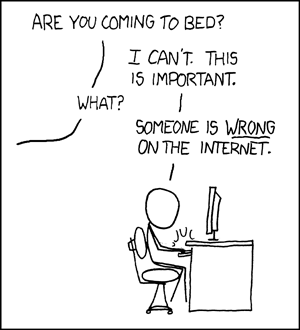
Rule #6: Never Argue with a Drunk or a Fool


Internet bullies are both. They are literally drunk on their own rage. Rage can trigger endorphins that create a high similar to cocaine or meth.

How far do you think you'd get using reason and logic with a crazed tweaker on the street? Right. Then don't try it on the Internet. Even if they are wrong. Because guess what? They almost always are.

This famous 2008 cartoon from xkcd says it all.


The most important thing to remember when you encounter unpleasantness is: take a breath, verify facts, and don't over-react. As Bob Mayer said on his blog last week: "The internet is a very dangerous place. I’ve seen internet lynch mobs go crazy over the slightest thing (done it myself a time or two) but a day or two of waiting and watching isn’t going to change anything."

When cybermonkeys start tossing verbal feces around a forum or blog, treat it like any other pile of poop.
  • Carefully walk around it.
  • Realize you don't have to tell anybody what it is. Its stink will give it away.
  • Call maintenance.
  • Go someplace cleaner.
You might want to send private messages of support to victims, but don't stand up for victims in cyberpublic no matter how much your inner Atticus Finch is hurting to speak.

I didn’t follow that advice recently and I'm still scraping stuff off my shoe.

Rule #7 Stay Out of Rough Neighborhoods


Absolute Write is no longer recommended. I used to suggest looking there for info on bogus agents and scam publishers. These days, it's so dominated by bitter, bad-tempered snark, you'd probably be safer with the scammers.

Amazon Forums: The Deadwood of the publishing frontier. Brutally anti-author and out of control with vigilantism.

LinkedIn Writers Groups. Some may be safe, but I've unsubscribed from all the ones I belonged to. Way too many rageaholics. LinkedIn is the most invasive of all social media and if you're not on it because of work, I'd recommend you stay away. They'll try to trick you into giving them access to all your email accounts so they can spam every one of your contacts mercilessly in your name, including every agent you've ever queried.

Goodreads: Mean Girls meets Lord of the Flies. This site has been desperately in need of adult supervision for a long time. Recently, they have made big steps in cleaning up the site, but I'd still suggest you stay in safe, author-oriented groups. (I'm fond of my BoomerLit group.) And don't read your reviews!

Or, to be really safe, follow the advice one agent tells her clients: "Go to Goodreads to put up an author profile. Link to your blog. Log out. Never go back."

Rule #8: Change your definition of "review" and don't take online reviews so seriously


1) An online product review is nothing like a traditional book review. When most of us think of a book review, we think of something in the New York Times, or a thoughtful assessment of a work written by a sincere blogger who has read the book and done some careful thinking and writing about it.

But online product reviews—as established in the early days of the Internet—are essentially comments, like the comments you see at the end of online news stories or a You Tube entry.

That means some online "reviewers" bear the same resemblance to traditional book reviewers that homicidal baseball fans do to sports commentators: not much.

2) Cruel, angry reviews say more about the reviewer than they do about your book. And they put you in excellent company.  I know yours hurt like a physical wound, but it helps to read some of the idiotic one-stars of the classics.

3)  It's an urban myth that Amazon requires a certain number of reviews or stars or "likes" on your author page to "move you up the ranks." Only one thing does that: sales.

Some advertising newsletters like Kindle Nation Daily, E-Reader News Today and BookBub do require tons of 5-star reviews, but I think that encourages gaming the system so I use advertisers that don't, like E-Book Bargains UK.

For actual readers, it's much more important to have a few good reviews and some good editorial reviews from well known authors. So don't obsess.

4) A lot of people view retail site reviews as a place for comic relief. Some can be hilarious. Actor George Takei recently made "top reviewer" status on Amazon for his reviews of odd products. I dare you not to laugh.

Others can be morbid and weird, like the Yelp reviews of the hotel where a body was found in the water cistern, or reviews of a wife-killer's "self-help" books.

5) Bad reviews don't always mean bad sales. One young writer engaged in an ill-advised snark battle with an ex that ended up in getting her book over 100 one-star nasty, racist reviews. But her book seems to be selling briskly.

6) Amazon also has an ultra-competitive "top 500/100/50 reviewer" program and you can get caught in their games. According to many reports, Grand Theft Auto mentality is rampant there. Reviewer-on-reviewer bullying and competition can be toxic. I've seen them use review comments and "useful" voting buttons to harass each other. Or they give one-stars to books their rivals love. With the author or vendor getting caught in the middle.

This is obvious breach of Amazon rules, so clicking the "report abuse" button usually solves the problem, but it can be traumatizing for the baffled author.

There is a rigid Amazon review culture and fall afoul of it at your peril. I've just heard of a new book about it called How to Get Good Reviews on Amazon by Theo Rogers, which may explain some more of the arcane rules.

7) Most people who write product reviews and comments are sincere, helpful customers, and some Amazon book reviewers are old school literary experts who could be published in any upscale magazine.

The best way to clean up the review system is add your honest reviews to the mix. Join the ranks of the sincere and helpful! 

I know sometimes it seems as if nastiness on the Interwebz is getting worse, but according to some, it's actually turning around. In the May 2013 issue of Esquire, Stephen Marche said: "The Internet has reached peak hate. It had to. At every other moment in history when there has been an explosion of text — whether through social change, like the birth of a religious movement, or technological change, like the advent of print — a period of nasty struggle ensued before the forces of civility reined it in."

Let's hope for those forces of civility to step in soon.
***

Please don't discuss any specific recent incidents of bullying in the comments, or we'll attract monkey-poo (and if you see it, don't respond. Let it stink for itself.)

But don't keep bullying stories to yourself. Lawyers, law enforcement, and journalists are collecting information and will be grateful for your input. You can leave an incident report for NBC news here. There's more info at the International Bullying Prevention Website.

What about you, scriveners? Do you think Internet can be civilized? What other rules should writers follow to stay safe? Can you recommend other safe places for writers? Know of any other bad neighborhoods we should avoid? Do you think retailers should drop the "star" system on online reviews?


Book Bargain of the Week

Food of Love: a comic thriller about dieting, chocolate, and a small nuclear bomb.

Part thriller and part screwball romantic comedy, Food of Love is a rollercoaster comedy that also addresses complex issues about body image, religion and a woman's right to choose.
Usually $2.99, now only 99c on Amazon , Amazon UK and NOOK


"This hilarious page-turner packs a profound satirical bite. It's a Hollywood romp that provides romance, mystery, and an honest confrontation with the human condition. Food of Love is a funny and powerfully healing book." ...Lucia Capacchione, PhD, bestselling self-help author, Recovery of Your Inner Child

Opportunity Alerts

Looking for an editor? Are you an editor? Sign up for GalleyCat's Freelance Editor Directory. 
As a service to the writers and editors in the GalleyCat audience, they are building a free, automatically updated directory where editors can post their services and writers can seek freelance editors. It's FREE. GalleyCat is one of the top resources in the publishing industry.

Become a Certified Ghostwriter! with the only university level course in ghostwriting. Designed to expand or launch lucrative, professional careers, this course meets online Mondays from 5:30 - 8:30 PM Pacific beginning Oct 14, 2013. Certification at the end of the two semesters is conferred by California State University, Long Beach.

Boomers!! The Huffington Post's Huffpo50 is now publishing short fiction! The rules: You must be 50 or older to enter. Writers can submit only one story per year, and all pieces must be 5,000 words or less. Send your original submissions, as well as your contact details, to 50fiction@huffingtonpost.com.

Get your book international visibility for a reasonable price. EBUK
is now advertising bargain books to a dozen countries, including the US and Canada. You can get more info here. Make sure your book is under $3.99 and provide links to all stores, not not only Amazon (unless you're in Select.) Ads are a little over 10 bucks until the end of August. And you can sign up for the newsletter for your country right here. I've signed up for the new US version. If you like bargain ebooks, this is a great free service.

Military Sci Fi Anthology. VFW: Veterans of Future Wars from Martinus Publishing. Write Military stories? Could one of them be set in the future? This is the anthology for you! 2000-6000 words. Make sure to follow submission guidelines. No docx files. Deadline Dec. 31, 2013.


***

This month Anne has an article about the pressures social media puts on authors at Talking Writing, the magazine for creative writers and readers.

Social Media Secrets Book Marketers Don't Tell You—Part I: How to Avoid Twitter-Fritter and Facebook-Fail


First: many thanks to Indies Unlimited, which named this blog to its 10 Blogs and Websites Every Indie Should Know. If you're an indie, or thinking of going indie (self-publishing or small-press), do follow them for great tips and news from a very savvy team of writers.

Most writers these days know a good book isn't enough to get you successfully published. Any agent, editor, or book reviewer is going to Google you first—often before they'll even read to the end of your query. Certainly before they request a partial or a book to review.

What comes up on that Google search can make the difference between getting an agent, publisher and reviews—or languishing in obscurity.

Yes, of course it's possible to become a successful author without an online presence, the same way it's possible to get hired for a corporate job if you write your resume on parchment and send it by carrier pigeon.

But your chances are a whole lot better if you conform to established standards.

A couple of months ago, I wrote about how authors spend too much time doing meaningless busy work trying to "build platform." 

But I didn't say authors can ignore social media entirely. Social media is our most important tool for getting our books discovered.

Being on social media takes you out of the confines of your own backyard and puts you into the global marketplace. It makes the difference between hawking your book on a local street corner and getting it in front of millions of readers all over the world.

Thing is: we need to learn to use this tool effectively.

Unfortunately, a lot of marketers don't seem to know how to do that, so they bully authors into wasting a huge amount of time playing meaningless number games.

Understandably, some authors are getting annoyed. Last week, much-lauded literary author Benjamin Anastas quit Twitter and vented in an eloquent blogpost. It got a lot of cyberink and sparked some interesting pieces by Jane Friedman and Porter Anderson.

Mr. Anastas voiced his many quarrels with Twitter, most of which boiled down to: Twitter is no good for selling books, and therefore a waste of time.

Thing is, he's right on the first point, but not on the second.

To me, it sounded like somebody saying he was going to get rid of his phone because it's not good for selling aluminum siding to strangers who are just sitting down to dinner.

Mr. Anastas is a smart man, so I suspect the problem is he was never told what Twitter is really for. (Maybe because his marketing department doesn't know either.)

So...ta-da!

Here is the big secret about Twitter: 


It is not a direct marketing tool. It is a method of communication.

Kinda like a phone. Here's some stuff Twitter IS good for:

1) Quick communications with a large number of people. 

Example: When I was in despair trying to get this blog's Feedburner email program to work last week, I Tweeted asking for help. Within minutes, I had several suggestions, plus a step-by-step guide for converting to a free Mail Chimp email service. (Thanks, Molly Greene!)  I hope I've done it right. Do tell me if you've subscribed and you're still not getting your email notices, or if it's missing from your rss feed.

2) Getting up-to-the minute news from anywhere on the globe.

Example: When there was a tornado in Tuscaloosa, and I wanted to know if my Tuscaloosa friends were OK, I went to #TuscaloosaTornado and found hundreds of real-time Tweets telling what neighborhoods had been hit.

3) Giving your friends a shout-out (and occasionally yourself.)

Example: When I saw that a friend who's a newly minted agent had been mentioned in Publishers Lunch, I Tweeted it, with a @ message to her. It was the first she'd heard of it, so it was a two-bird stone. I informed her of the good news and at the same time let a lot of people know about her new agency.

And yes, you can toot your own horn occasionally. You can certainly Tweet "my book was just nominated for a RITA" or "I got a rave review from Big Al."

But only do this a few times. Imagine you're phoning your friends with the good news, not cold-calling everybody in the phone book.

However, the most important Tweets might be for a friend's triumph. This week, a Tweep posted a link with an @ message congratulating us on our Indies Unlimited kudos. I thought—"what a nice thing for her to add a special Tweet to me. Who is she, again?" I visited her blog, was intrigued, and bought one of her books.

Yeah. That's how it works.

4) Connecting with people. 

Example: Somebody asks a question on this blog. I take some time with the answer and want to let the commenter know there's an answer waiting. If her name leads to a Twitter profile, I tweet her a heads-up. Yes, I could send an email or DM, but a Tweet lets other people who might be interested know the post is there, too. I might add a hashtag like #blogging if that's what it's about.

That way we've made one connection on the blog and another through Twitter. That means we'll take more notice of each other the next time we meet online.

5) Sharing information and talking about it.

This can be anything from Tweeting a tsunami warning for your patch of coastline to links to your own newest blogpost or an article about the new Veronica Mars movie (especially if your tweeps are mystery lovers.)

Example: A few days ago I Tweeted a link to an article about the copy of J.K. Rowling's pseudonymous book that sold for $6000+ and added I thought this thing was getting silly. A few people Tweeted back their responses, including Tweep AJ Sykes who said "Agreed. Or maybe it's ugh-greed."

Clever and funny. And I remember him saying some wise things in a comment on Jane Friedman's blog last week. So now he's on my radar as a clever, funny guy. I see he writes steampunk. Not my genre of choice right now, but I ever make the steampunk plunge I know where to go first.

See how that works?
  • Notice I did not say anything about telling strangers what you had for lunch. 
  • Or hammering them with "buy my book" messages. 
  • Or Tweeting endless snippets of text from your opus. (I know marketers love that, but it's so overdone it's all just noise to most of us.) 
Yes, you can tweet that a great book is free or on sale. And that book can be yours, but don't do it more than three times a day. In between other stuff.

And you can Tweet other people's books, too—but only if you genuinely think your followers will like it. Tweeting books you haven't read may seem to be "friendly" to your fellow authors, but it's not friendly to your Tweeps. And it can backfire if it's not a book you'd recommend to a real life friend. Somebody who writes violent thrillers has no business asking a writer of children's books or cozies for a Tweet. It's OK to say no.

Especially since simply Tweeting book titles at strangers does not sell a lot of books anyway. That's what Benjamin Anastas was right about.

But exchanging information can make connections. It's those connections that will get you known so that somebody might want to buy your books some day.

But you don't have to spend a lot of time on those connections. Mr. Anastas complained of Twitter being a time suck—and it certainly can be. But only if you let it.

And that's another way Twitter is like your phone. A phone can't dominate your life if you don't turn it on. Don't dump the phone, just don't pick up if you don't want to talk.

And those marketers who say you should be adding 20 random Tweeps a day so you can amass half a million followers?

That's like saying you should buy a phone with the numbers of 500,000 strangers programmed into it.

If they don't want to talk to you—what exactly is the point?

For more on Twitter—especially for newbies—see my post on Twitter for Shy Persons.

And for some info on how some clever people are making Twitter more useful for book marketing, check out Julie Valerie's review of BookVibe.  It's a new program that analyzes Twitter streams for book discovery. It sounds as if there still are some bugs in it, but it may mean that Twitter will be a better place for direct marketing in the future than it is now.

Now for some Facebook secrets…

I'm not going to pretend to be an expert on Facebook. I'm kind of a Facebook hater. But that's partly because it's taken me so long to learn to use it. For at least a year I didn't post anything but links to my blog, bits of publishing news, and announcements of my book launches (Yeah, I launched 7 in a year, plus 3 anthologies. I guess I didn't have much else to talk about.)

But this year I started posting literary cartoons, inspirational stuff about books, and a few jokes. All of a sudden, I started having fun conversations on FB.

And this week I saw a great post from Kristen Lamb that gave me an a-ha moment.

It solidified all the stuff I've been learning by trial and error for the past six months. (Lots of error.)

1) Don't just "friend" people.

BE a friend. Connect with people in a non-phony way. NOT writer to fan. Person to person.

2) A personal "friend" page is more valuable than a "like" page.

You can stop humiliating yourself begging for "likes." They mean absolutely nothing if people don't make return visits. And why do you want that Christian picture book writer to like your BDSM erotica page, anyway? It will do nothing for you and will signal Facebook to send some very unwelcome advertising her way.

People would rather be your friend than worship at your feet. Don't expect people to "like" you if you don't do anything likeable.

3) Nonstop bragging isn't especially likeable. 

How weird is it that I have to say that? But I do. That's because marketers tell us to advertise 24/7. When what we should be doing is joking around and getting to know people.

4) LOLCats, Oprah-quotes, and funny stuff from George Takei will sell more books in the long run than all those "book launch party" pages, pleas for tweets, or those links to Publisher's Lunch. (Yes, I'm seriously guilty of that last one.)

As Kristen said in her post: "People can’t connect emotionally to yet another DBW article about how Barnes and Noble’s stock is tanking. They CAN however connect to kittens, Sharknado, tales of missing socks, superheroes, kid stories, pet stories, Mayhem and Grumpy Cat."

5) Facebook author pages don't get much traffic because you can't use them to interact with people. They just sit there saying "worship me." All most of us do is post news about our books. Which snoozifies pretty much everybody if it's non-stop.

Here's Kristen again. "There are writers who seriously believe that Facebook is out to get them because their fan pages are being hidden. NO. It’s just that, in the Digital Age, there is a steep price for being boring."

I wish I'd read Kristen's post three years ago when I started on Facebook. I've wasted a lot of time being boring. Here's another quote:

"Engage us, talk to us, stop selling to us and guess what? We will like coming to your page. And we will have fun and "Like" stuff, comment and SHARE your content." It's worth reading her whole post.

6) The most important Facebook pages aren't your personal pages or your author page. (Or those endless promotional "event" pages.)

They are your friends' pages.

If you visit your friends' pages and make them feel like equals rather than minions, and encourage them through their triumphs and crises, the way you'd like them do do for you, they will reciprocate.

And they might even be interested in reading your next book.

Yeah. That's how social media works. It's, um, social. And as with all social interactions, the best rule is always the Golden one.

In August, I'm going to post Part 2. I'll be talking about how blogging revived my career, and I'll divulge the #1 blogging secret no blogging guru will tell you. 

So what about you, scriveners? Have you been feeling the way Benjamin Anastas does about Twitter? What do you think you could teach marketers about social media? Any tips to add about Twitter and Facebook?

THIS WEEK'S BOOK DEAL 

Sale extended! 99 cents for three hilarious mysteries. Thanks everybody, for keeping it in the top 50 in comic fiction on Amazon for five weeks!

Available on Amazon US, NOOK, and Amazon UK


"The Best Revenge, Ghost Writers in the Sky and Sherwood Limited are hysterical. Anne Allen will keep you laughing throughout, but in the meantime she dabbles her fingers in some topics worth some serious thought: sexism, weightism, lechery, murder, duplicity, homelessness & poverty to name a few. If you love to laugh, you'll like these three books. If you love to think, ponder AND laugh, be ready to fall in love"... C.S. Perryess


OPPORTUNITY ALERTS


1) The Alice Munro Short Fiction Contest. Entry fee $25 adult, $10 Teen. $2000 (Canadian) in prizes. 5000 words or less, unpubished work. More info at Alice Munro Festival Short Story Competition Deadline August 1.

2) Quirk Books "Looking for Love" contest. They offer a $10,000 prize for the best quirky love story of 50,000 words or more. Visit the Quirk Books website to download the entry form or for further information. Quirk Books was founded in 2002 and publishes around 25 books each year. Their bestselling titles include Pride and Prejudice and Zombies and Miss Peregrine’s Home for Peculiar Children. Entries close October 1.

3)  The Huffington Post's Huffpo50 is now publishing short fiction!   The rules: You must be 50 or older to enter. Writers can submit only one story per year, and all pieces must be 5,000 words or less. Send your original submissions, as well as your contact details, to 50fiction@huffingtonpost.com.

4) COMPOSE Literary Journal. Submissions are open for their Fall 2013 issue.  This prestigious journal was founded by Suzannah Windsor, of Write it Sideways, and she's put together an amazing editorial staff. They are looking for art and photography as well as poems, literary short fiction, novel excerpts and essays. Must not be previously published (that includes anything that has appeared on your blog.)

We love your comments! If you can't get through Blogger's hoop-jumping, send me an email at annerallen dot allen at gmail dot com and I'll post it personally.

Older Posts Home
Powered by Blogger.

Followers


Recent Comments